

Who Are The Dancers In Asia Young Girls Dressed In Gold Hand And Finger Movements Lots Of Makeup
| Three Genres of Traditional Dance in Bali | |
|---|---|
| UNESCO Intangible Cultural Heritage | |
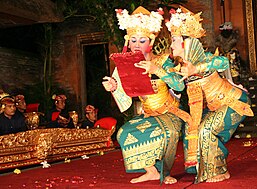 Legong Keraton Trip the light fantastic toe performance with Gamelan ensemble in Puri Saren Ubud, Bali, Indonesia | |
| Country | Republic of indonesia |
| Criteria | Oral traditions and expressions, including linguistic communication as a vehicle of the intangible cultural heritage, performing arts, social practices, rituals and festive events, noesis and practices apropos nature and the universe, and traditional adroitness |
| Reference | 617 |
| Region | Asia and the Pacific |
| Inscription history | |
| Inscription | 2015 (tenth session) |
| List | Representative List |
 Wali Sacred Dances (Rejang, Sanghyang Dedari, Baris Upacara), Bebali Semi sacred Dances (Topeng Sidhakarya/Topeng Pajegan, Gambuh dance drama, Wayang Wong trip the light fantastic drama), Balih-balihan Entertainment Dances (Legong Kraton, Joged Bumbung, Barong Ket) | |


Kecak dance performed by many male dancers.
Balinese trip the light fantastic is an aboriginal trip the light fantastic tradition that is function of the religious and artistic expression among the Balinese people of Bali island, Indonesia. Balinese dance is dynamic, angular and intensely expressive.[1] Balinese dancers limited the stories of dance-drama through the actual gestures including gestures of fingers, hands, head and eyes.
There is a great richness of dance forms and styles in Bali; and peculiarly notable are those ritualistic trip the light fantastic toe dramas which involve Rangda, the witch, and the great beast Barong. Most of the dances in Bali are connected to Hindu or traditional folk rituals, such every bit the Sanghyang Dedari sacred trip the light fantastic toe that invoke benevolent hyang spirits, believed to possess the dancers in a trance state during the performance. Other Balinese dances are not linked to religious rituals and are created for sure occasions or purposes, such every bit the Baris or Pendet welcoming dances and Joged dance, that is social dance for entertainment.
Recognition and conservation [edit]
During the Intergovernmental Committee for the Safeguarding of the Intangible Cultural Heritage convention in 29 Nov to 4 Dec 2015 in Windhoek, Namibia, UNESCO recognizes three genres of traditional trip the light fantastic in Bali, Republic of indonesia, as Intangible cultural heritage.[2] The three genres includes Wali (sacred dances), Bebali (semi-sacred dances) and Balih-balihan (dances for entertainment purposes). Balinese dance has been proposed since 2011,[iii] and officially recognized in 2015.
The three genres are represented past nine dances, which describes its function and living tradition in Balinese community, they are:[4] [5]
- Wali Sacred Dances
- Rejang (Klungkung District). Sacred ceremonial dance by young women in traditional ceremonial dress,
- Sanghyang Dedari (Karangasem District). Sacred trance trip the light fantastic to counteract negative supernatural forces. Performed past 2 young girls.
- Baris Upacara (Bangli District) religious dances conveying heroic spirit danced by fifty-fifty numbers of male person dancers.
- Bebali Semi Sacred Dances
- Topeng Sidhakarya/Topeng Pajegan (Tabanan Commune). Performed past masked dancers to neutralize the evil spirits.
- Gambuh dance drama (Gianyar District). Formerly imperial theatrical operation, now accompaniment to ceremonies, past 25-40 dancers.
- Wayang Wong trip the light fantastic toe drama (Buleleng District). Combines trip the light fantastic, ballsy drama and music.
- Balih-balihan Entertainment Dances
- Legong Kraton (Denpasar City). Exquisitely beautiful dance by two or 3 girls. Developed from Sanghyang Dedari, and Gambuh.
- Joged Bumbung (Buleleng District). A popular social trip the light fantastic past couples, during harvest season or on important days.
- Barong Ket "Kuntisraya" (Badung District). Represents a fight betwixt two mythological characters, Barong in the class of a panthera leo symbolizing goodness and Rangda, an evil witch.
Significance [edit]

Ornaments used in Balinese dances.
In Hinduism, dance is an accompaniment to the perpetual dissolving and reforming of the world. The artistic and reproductive balance is often personified as Shiva's married woman, Durga, sometimes called Uma, Parvati, or Kali. This has significance in Balinese Hinduism, since the common figure of Rangda is similar in many ways to Durga.[6]
Variants [edit]

In Bali there are various categories of dance,[7] including epic performances such as the omnipresent Mahabharata [eight] and Ramayana. Certain ceremonies at village temples feature a special operation of a dance-drama, a battle between the mythical characters Rangda, the witch representing the evil, and Barong, the lion or dragon, representing the skillful. This type of performance was traditionally featured during outbreaks of epidemic diseases which were believed past the people to be a result of a disturbance in the rest of the 'good and bad forces', which were represented by the Rangda and the Barong. The boxing usually reconciles in harmony or balance of the Rangda and the Barong, instead of a defeat of the evil.
Amid the trip the light fantastic toe traditions in Bali are:
- Barong, king of the spirits
- Baris war dances
- Cendrawasih, the bird of paradise
- Condong, a basic dance, preface to Legong
- Legong, a refined trip the light fantastic toe
- Kecak, the Ramayana monkey dirge trip the light fantastic toe
- Janger, a sitting dance with swaying movements
- Pendet, a simple trip the light fantastic performed before making an offering at a temple
- Tenun, a dance describes women weaving the material
- Topeng, a mask dance
Traditionally, sacred dances can only be performed in temples. However, new choreographies have been created due to the need from tourists. One example, Tari Sekar Jagat (Tari means dance in the Balinese language), is a relatively new choreography that has become popular. In the newer creations, choreographers have more than freedom over the moves. They employ new moves that were considered 'improper' for the sacred dances. For example, in Tari Sekar Jagat, there is a motility when the dancers agree the Dulang below their shoulders. This ceremonial pedestal, which may be wooden or ceramic, is normally held high in accordance with its sacredness. Below shoulder level but above the bellybutton represents an ordinary or everyday state.[nine]
Technique [edit]

A woman dancing Legong Bapang Saba. Balinese dances incorporate center and facial expressions.
Bali dancers learn the craft as children, they are played Balinese music. They are taught to dance with their hands before they tin walk. Official training as a Bali dancer starts every bit young equally 7. In Balinese dance the movement is closely associated with the rhythms produced past the gamelan, a musical ensemble specific to Coffee and Bali.[ten] Multiple levels of articulations in the confront, eyes, easily, arms, hips, and anxiety are coordinated to reflect layers of percussive sounds.
The number of codified hand positions and gestures, the mudras,[eleven] [12] [13] is college in Republic of india than in Java or Bali. It has been speculated that they have been forgotten every bit the dance was transmitted from Republic of india to Java.[fourteen] Mitt positions and gestures are still every bit of import in Javanese and Balinese dance equally in India.[15] Whether in Bharat, Indonesia or Kingdom of cambodia, hands have a typically ornamental role and emphasize the dance's fragile intricacy.
-
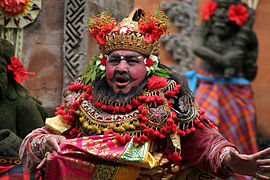
A human dancing Balinese Barong.
-

Balinese Tari tenun (weaving trip the light fantastic) mass trip the light fantastic toe, performed by hundreds of dancers.
-

Balinese Tari pendet, performed by hundreds of dancers.
-

Balinese people learn to dance since babyhood. Balinese trip the light fantastic is a living tradition incorporated inside the everyday mode of life.
Gallery [edit]
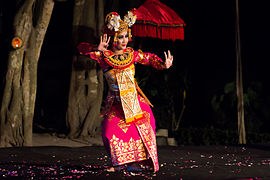
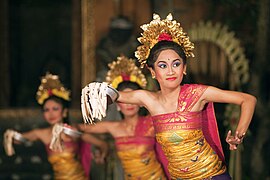
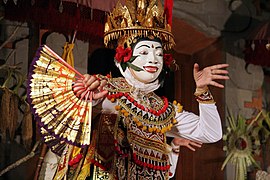
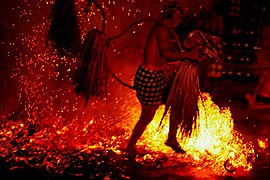
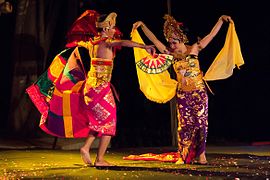
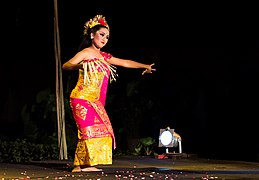
- Some examples of Balinese Traditional dance
-

-
-

-
-

-
-

-
-

-

-
-
See also [edit]
- Dance in Indonesia
- Javanese trip the light fantastic
- Sundanese dance
- Dance of Cambodia
- Dance of Thailand
- Theatre in Bali
- Hinduism in Bali
- Dance in mythology and religion
- Listing of bones dance topics
- List of trip the light fantastic fashion categories
- Listing of dances
References [edit]
- ^ Lieberman, Fredric. "Relationships of Musical and Cultural Contrasts in Java and Bali". University of California Santa Cruz. Retrieved March 9, 2013.
- ^ "Traditional dances, crafts, knowledge and music on the calendar at Intangible Heritage Commission meeting in Namibia". UNESCO . Retrieved i December 2015.
- ^ "Traditional dances proposed to exist world's heritage". The Djakarta Post. 16 November 2011. Retrieved 1 December 2015.
- ^ "Three genres of traditional dance in Bali, Representative List 2015". UNESCO . Retrieved i December 2015.
- ^ "Representative List of the Intangible Cultural Heritage of Humanity, Republic of indonesia: Traditional Dances of Bali" (document). Retrieved i December 2015.
- ^ Bali: Sekala and Niskala :Essays on Religion, Ritual, and Fine art (Bali--Sekala & Niskala) past Fred B., Jr. Eiseman (1989) p. 24
- ^ The Folk Art of Bali: The Narrative Tradition (The Asia Collection) by Joseph Fischer and Thomas Cooper (1998)
- ^ Story Cloths of Bali by Joseph Fischer (2004) p.57
- ^ Fred B. Eiseman, Sekala and Niskala: Essays on Faith, Ritual and Art. Tuttle, 2009.
- ^ Operation in Java and Bali by B. Arps (1993) p.77
- ^ Mudras: Yoga in Your Easily by Gertrud Hirschi (2000)
- ^ Mudras in Buddhist and Hindu Practices: An Iconographic Consideration by Fredrick W. Bunce (2005)
- ^ The Music and Dance of the World's Religions: A Comprehensive, Annotated Bibliography of Materials in the English Language (Music Reference Drove) past Eastward. Gardner Rust (1996) p.72
- ^ Burmese Dance and Theatre (Images of Asia) past Noel F. Singer (1996)
- ^ A Lexicon of Theatre Anthropology: The Undercover Art of the Performer past Eastward. Barba (2005) p.156
External links [edit]
Source: https://en.wikipedia.org/wiki/Balinese_dance
Posted by: parkinsondiand1963.blogspot.com
0 Response to "Who Are The Dancers In Asia Young Girls Dressed In Gold Hand And Finger Movements Lots Of Makeup"
Post a Comment